Objects built to be poured
Set aside what the tumbler and dabarah are used for and judge them only as design, and they turn out to be solving a harder problem than a cup and saucer ever had to.
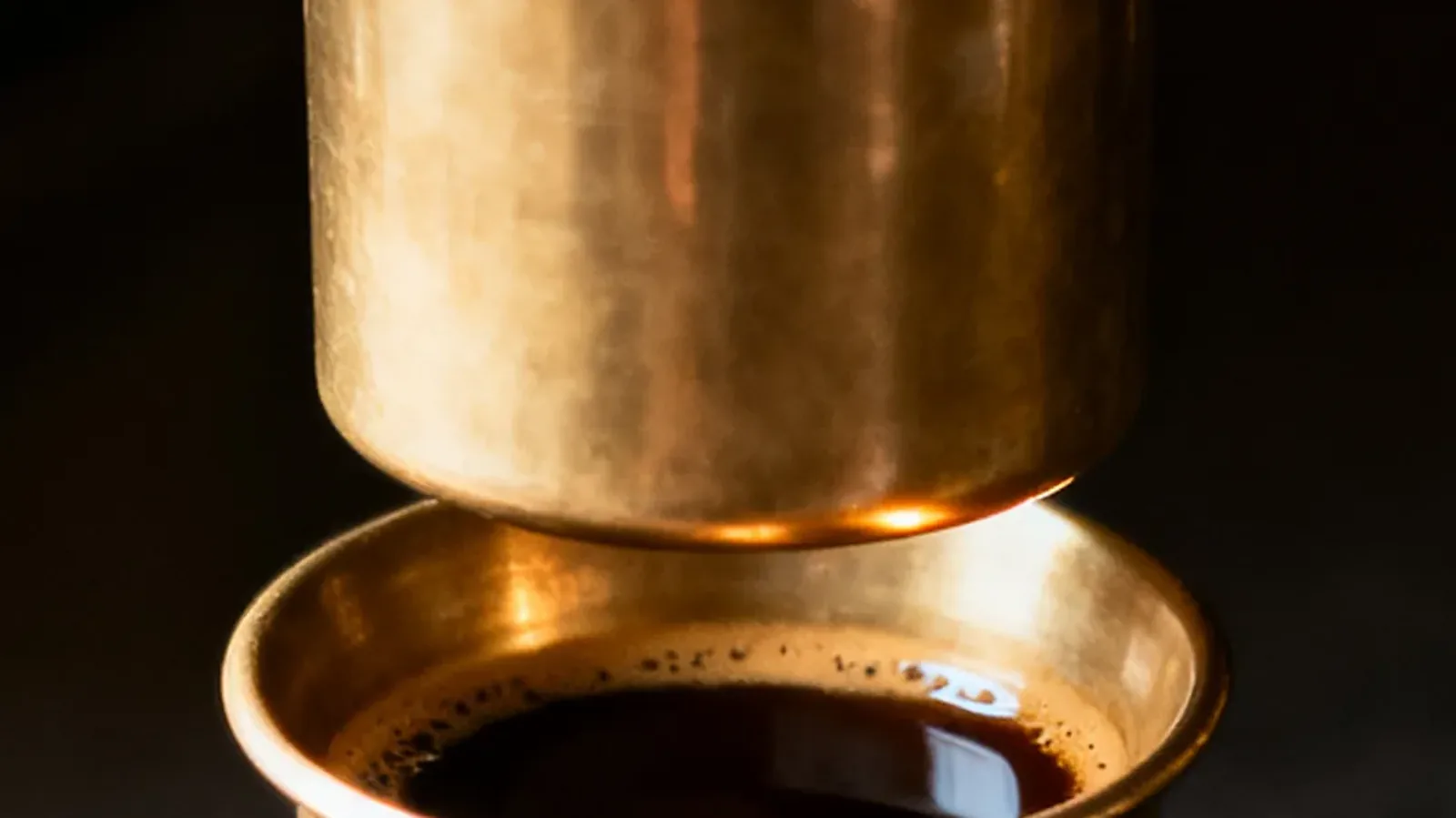
A cup is designed to be held still and drunk from. Almost every choice in its shape follows from that one job: a handle to keep hot metal or ceramic away from the hand, a rim shaped for the lips, a saucer to catch what spills. The tumbler and dabarah were not designed for that job at all. They were designed to be poured between, in the air, repeatedly, while full of coffee close to boiling, and to end up cool enough and frothy enough to drink. That is a genuinely different design problem, and it is worth looking at what solving it actually required.
No handle, on purpose
The obvious question is why the tumbler has no handle when it holds hot liquid. The answer is that a handle would get in the way of the one thing the tumbler exists to do, which is pour cleanly from a height without spilling. A handle adds a pivot point and a place for the stream to catch. The tumbler instead relies on its simple shape and rolled lip, held with a light touch. It is a solution that looks like an omission until you have poured from one.
The dabarah is doing three jobs at once
The wide, shallow bowl that catches the tumbler is not a decorative flourish and it is not simply a saucer scaled up. Its width is what lets the pour cool the coffee across a long thin fall rather than a short one. Its shallowness is what lets it double as a drinking vessel in its own right, without the rim of the tumbler ever needing to touch anyone's mouth. And its flat, stable base is what makes it possible to hold, pour and catch with two hands doing two different jobs at once. A cup and saucer were never asked to do any of that, because nobody pours a cup and saucer at arm's length above another cup and saucer.
Nothing about the tumbler and dabarah is decorative. Every curve is answering to the pour.
Two vessels instead of one
The most striking design decision, seen from outside, is that the whole system uses two vessels for one drink. Most cultures settled on one cup per person and stopped there. The South Indian filter set insists on two, nested, working together, and that is because a single vessel cannot do what the pair does. One vessel cannot cool its own contents by moving them through the air. One vessel cannot be filled, emptied and refilled from itself. The second vessel is not a spare. It is the mechanism.
Materially the choice of metal is doing similar work. Metal conducts heat fast, which sounds like the wrong property for something meant to be held, until you notice that the whole system was built around that speed rather than against it: the coffee gets too hot to drink the moment it is poured, and the pouring is exactly what solves that. A ceramic cup would hold its heat evenly and quietly. A metal tumbler forces the issue, and the dabarah is the answer it forces. Judged purely as objects, without reference to what they are used for, the tumbler and dabarah are an unusually complete piece of design: nothing on them is there by accident, and nothing that is needed is missing.
From the shop
Our coffees, 80:20 with chicory
Ground and packed fresh, only after you order.



More essays
 Why the hand filter is still in the kitchenEspresso machines and electric filter-coffee makers are easy to buy, and some homes use them. Many South Indian kitchens still reach for the plain metal filter first, and taste is only part of why.3 min read
 The twenty minutesFilter coffee is one of the few things left in a house that refuses to be rushed, and that refusal is doing more work than the coffee itself.3 min read
 A case for drinking coffee out of metalCeramic and paper won the argument in most places coffee is drunk. Metal is still how South India takes its filter coffee, and that holdout is worth defending on its own terms.3 min read