Reading a coffee pack properly
A coffee pack states more than most people read, and stays quiet about more than most people notice. Here is how to read all of it, not just the ratio.

Most people read one thing on a coffee pack, the ratio, and stop there. That number matters, but it is only one declaration among several, and the ones that get skipped over are often more informative than the one everybody reads.
What the pack is required to say
The coffee-to-chicory ratio, 100% Coffee or 80:20 and similar, is a required declaration, which is exactly why it can be trusted at face value: it is not a marketing choice, it is a regulatory one. The net weight is the same kind of declaration. So is a manufacturing or packing date, and so is a best-before period. None of these are claims a shop invented to sound good. They are facts the pack is obliged to state, which is precisely what makes them worth reading closely and worth trusting more than anything phrased as an adjective.
A required declaration is worth more than a confident adjective, precisely because nobody chose to put it there.
What the pack chooses to say
Everything else on a pack, the name of a blend, a line about where the coffee is sourced from, a description of its character, is a choice rather than an obligation, and it deserves a different kind of reading. "Selected from established coffee-growing regions of Karnataka and Kerala" is a true and specific claim, but it names regions, not estates, because that is the level of detail that can honestly be stood behind. A pack that names a single named estate or farm is making a much narrower claim, and it is worth asking, quietly, whether that claim is actually being sourced against or simply sounds better on the front of the bag.
What the pack leaves out, and why that matters
Some things are genuinely and permanently absent from a coffee pack, and their absence is not an oversight. The exact make-up of a blend, its internal grading, the per-kilogram cost of sourcing, the identity of a specific supplier: none of this appears, anywhere, on any pack, because it is commercially confidential information rather than something being withheld from a curious buyer. Knowing that in advance changes how you read a pack that stays quiet about it. It is not evasive. It is the same kind of confidentiality any business keeps about its costs and its suppliers.
- Ratio, net weight and dates: required declarations, read these first and trust them literally.
- Sourcing region, blend name, character description: chosen language, worth a second look at how specific it actually is.
- Bean composition, technical grade, supplier identity and per-kilogram cost: confidential everywhere, its absence is normal, not a red flag.
Read this way, a coffee pack stops being a piece of persuasion and starts being a short, fairly honest document, once you know which lines on it were required and which were chosen. The required lines will tell you what is actually in the bag. The chosen lines will tell you how the shop wants you to feel about it. Both are worth reading. They are just not the same kind of information, and conflating them is how a pack ends up being trusted for more than it actually says.
From the shop
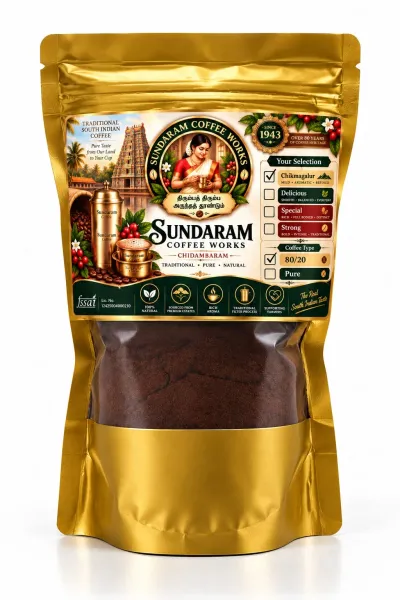
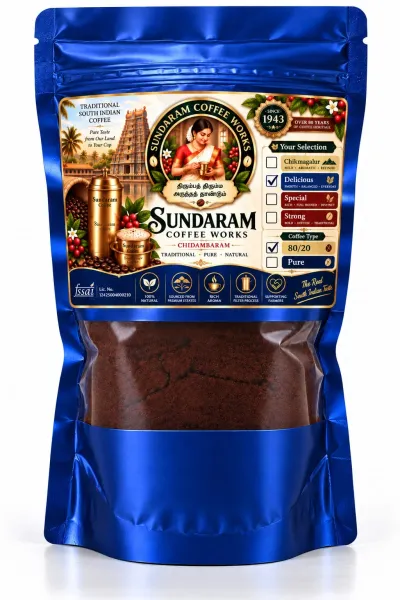
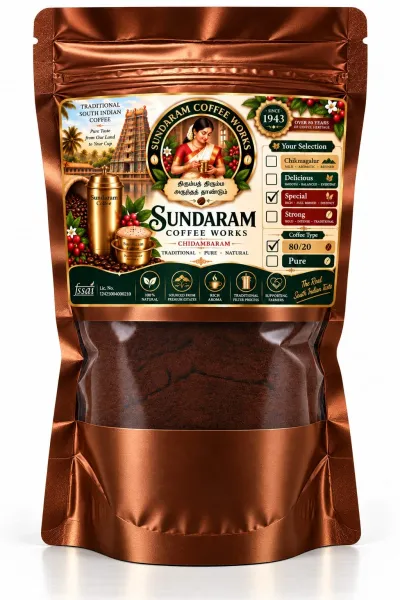
Our coffees, 80:20 with chicory
Ground and packed fresh, only after you order.
More essays
 The same cup, eight thousand kilometres awayA filter coffee made far from South India follows the same steps as one made on Kasukadai Street. Worth asking honestly what actually stays the same when it travels, and what quietly doesn't.3 min read
 What a small shop can actually doBeing small is not a marketing position. It changes what is genuinely possible, in both directions, and the honest version of that argument has to include what a small shop cannot do.3 min read
 Chicory's two livesIn parts of Europe, chicory in coffee is remembered as a wartime substitute. In South Indian filter coffee, many people drink it by choice.2 min read